

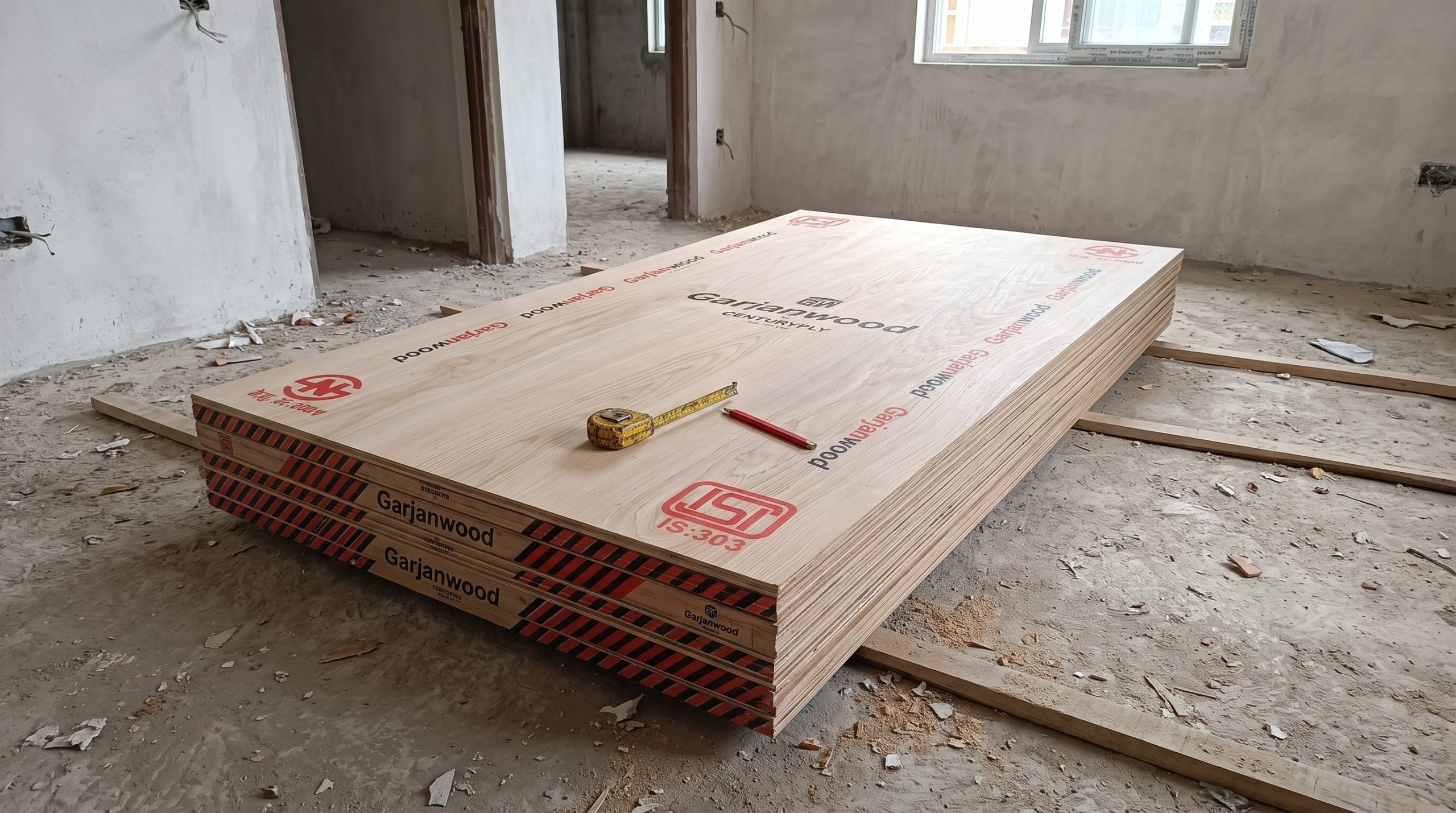
You have measured the flat, seen the designs, and now the carpenter says, “We will need plenty of plywood.” But how many sheets is plenty? Order too few and work stops halfway while you wait for more boards that may not match. Order too many and you pay for offcuts that sit in a corner for years. This guide answers the question buyers ask most: how many plywood sheets for 2BHK homes in Nepal, with a room-by-room estimate and a simple formula you can check yourself.
Every home is different, so treat the numbers below as planning ranges. Your carpenter’s cutting plan gives the final count.
Start with the Basics: What One Sheet Covers
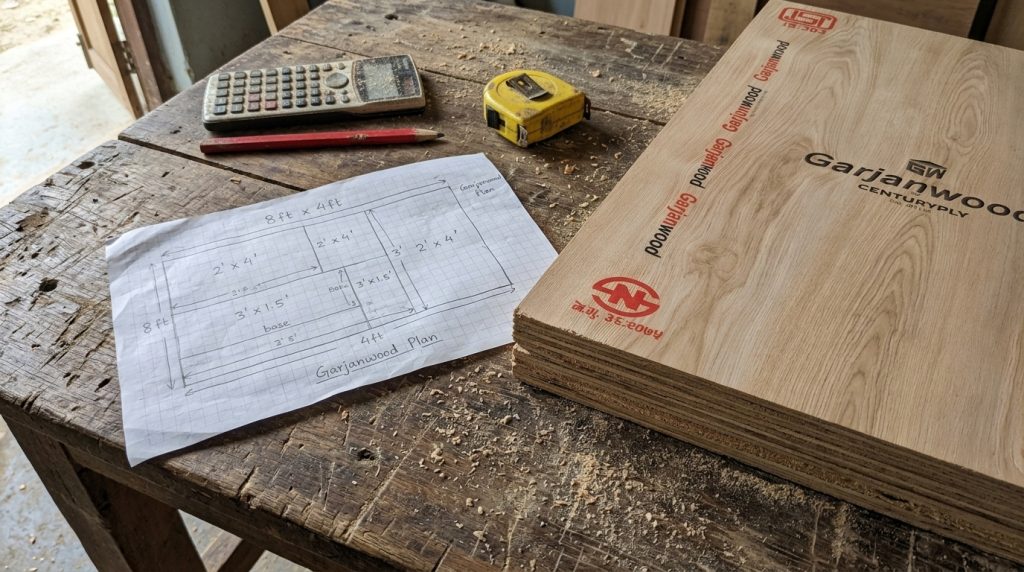
The standard plywood sheet in Nepal measures 8 ft by 4 ft, which is 32 square feet (about 2440 mm by 1220 mm). Every estimate begins with that number. If your furniture needs 160 square feet of board, that is five sheets before wastage.
Three things change the count for every project:
- Thickness: Carcass parts such as sides and shelves usually use 18 mm. Back panels use 6 mm. Shutters may use 12 mm or 18 mm.
- Design complexity: Curves, carved panels and many small parts create more offcuts.
- Cutting skill: A good carpenter plans the layout on paper first and wastes far less.
The Simple Formula
Use this to check any quote:
Sheets needed = (total board area in square feet ÷ 32) × 1.12, rounded up
The 1.12 adds about 12 per cent for wastage, which suits most standard furniture. Use 1.15 for curved or carved designs, and 1.08 for very simple box shapes.
A Worked Example: One Wardrobe
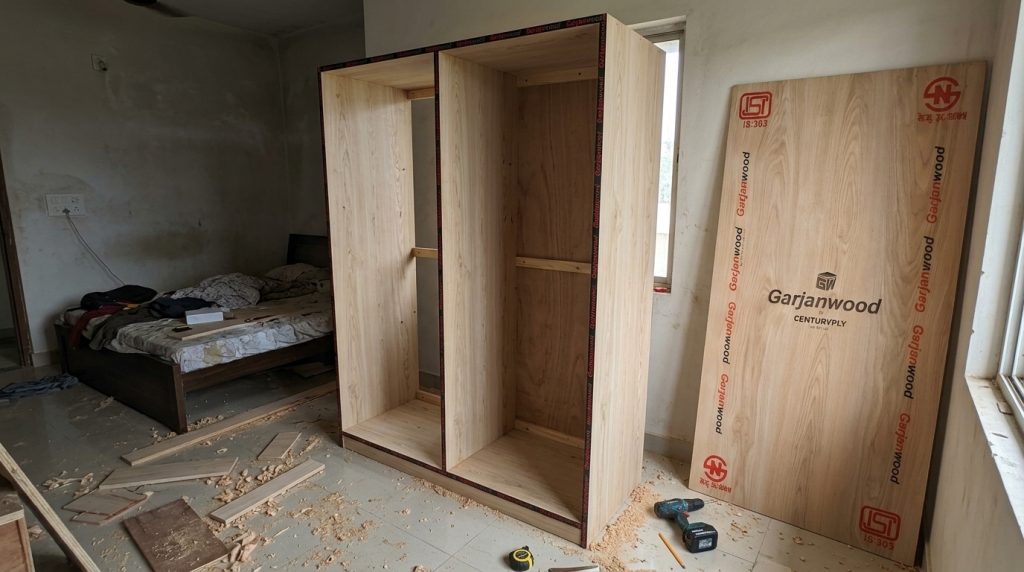
Take a wardrobe 6 ft wide, 7 ft high and 2 ft deep with a middle divider, three shelves and hinged shutters.
| Part | Approximate area |
|---|---|
| Two sides (7 ft by 2 ft each) | 28 sq ft |
| Top and bottom (6 ft by 2 ft each) | 24 sq ft |
| Middle divider (7 ft by 2 ft) | 14 sq ft |
| Three shelves (3 ft by 2 ft each) | 18 sq ft |
| Shutters (front area, 6 ft by 7 ft) | 42 sq ft |
| Drawers and small parts | about 15 sq ft |
| Total in 18 mm | about 141 sq ft |
141 ÷ 32 = 4.4 sheets. With wastage, that is about 5 sheets of 18 mm. The back panel adds roughly 42 sq ft of 6 mm board, so plan 2 sheets of 6 mm. One wardrobe needs about 5 thick sheets and 2 thin ones.
Room-by-Room Estimates for a 2BHK
The ranges below assume typical sizes and standard designs. Larger or more detailed pieces will push you to the upper end.
| Item | Typical size | 18 mm sheets | 6 mm sheets |
|---|---|---|---|
| Master bedroom wardrobe | 6 to 8 ft wide, floor to ceiling | 5 to 7 | 1 to 2 |
| Second bedroom wardrobe | 5 to 6 ft wide | 4 to 5 | 1 to 2 |
| Double bed with storage | Queen size platform | 3 to 4 | 0 |
| Single or kids bed | Single platform | 2 to 3 | 0 |
| Dresser or side tables | Small units | 1 to 2 | 0 |
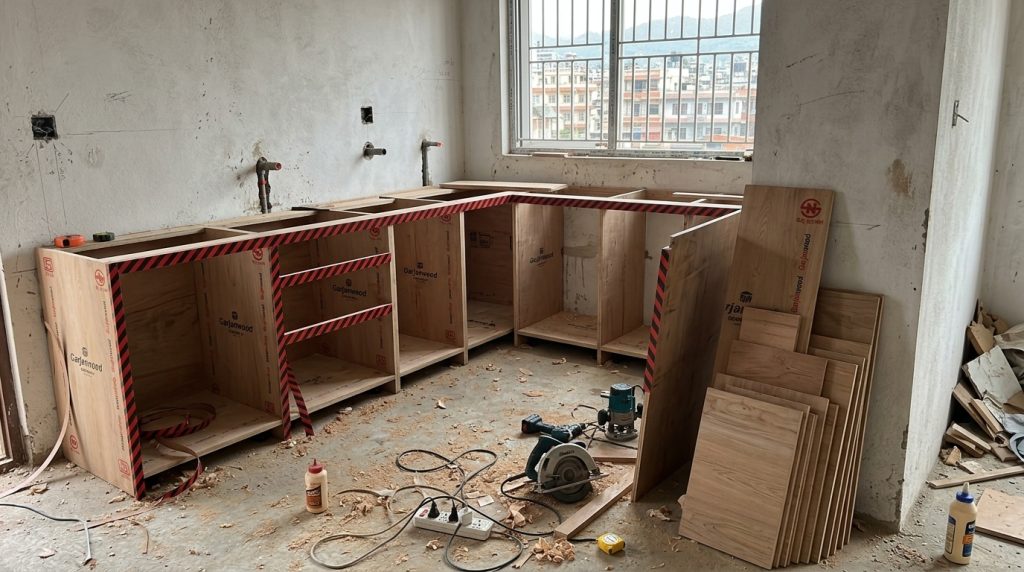
| Modular kitchen, 10 ft straight run | Base and wall units | 6 to 8 | 1 |
| Modular kitchen, L shape of 15 to 18 ft | Base and wall units | 10 to 12 | 1 to 2 |
| TV unit with back panel | 6 ft wide | 3 to 4 | 0 to 1 |
| Shoe rack and entry storage | Compact | 1 to 2 | 0 |
| Study table with drawers | 4 ft wide | 1 to 2 | 0 |
Adding a typical set, such as two wardrobes, one double bed, one single bed, a 10 ft kitchen, a TV unit and a shoe rack, usually lands in the range of roughly 25 to 35 sheets of 18 mm plus 5 to 8 sheets of 6 mm. A fully fitted home with an L-shaped kitchen and extra storage can reach 40 sheets or more.
Why Wastage Is Not Always a Waste
Offcuts feel like lost money, but a smart carpenter turns them into useful parts.
- Ask for a cutting plan. A simple sketch showing how each part fits on a sheet reveals wasted areas before any cutting begins.
- Use offcuts for small parts. Drawer bases, shelf supports, kick plates and internal partitions can come from leftover pieces.
- Respect grain direction. Visible parts should follow the grain consistently, which can limit how tightly pieces nest.
- Keep leftover boards for repairs and future changes, since matching a later sheet exactly is difficult.
Choosing Thickness for Each Part
Using the right thickness in the right place keeps costs down without sacrificing strength.
- 18 mm: Carcass sides, tops, bottoms, long shelves, bed platforms and tabletops.
- 12 mm: Shutters, drawer sides and lighter partitions where load is low.
- 6 mm: Back panels, drawer bases and decorative backing.
Do not thin out shelves that carry heavy loads, such as books or kitchen appliances. A thinner board saves little and sags quickly.
Where Grade Matters More Than Quantity
Counting sheets is only half the plan. The grade you choose decides how the furniture behaves over years.
- Kitchens and areas near bathrooms: Choose boiling water proof (BWP) grade for base units and anything near the sink.
- Bedrooms and living areas: Standard interior grade is often enough in dry rooms, though many families prefer BWP across the home in humid regions.
- Ground floor and Terai homes: Moisture is a bigger risk, so lean towards water-resistant grades and seal every edge.
Ask your dealer to name the grade on the quote. A quote that only says “plywood” gives you no way to compare options.
Practical Tips Before You Order
- Order all sheets together. Boards from different batches can vary slightly in colour, thickness and surface finish, which shows in visible parts.
- Add a small buffer, around one or two sheets, for mistakes and changes.
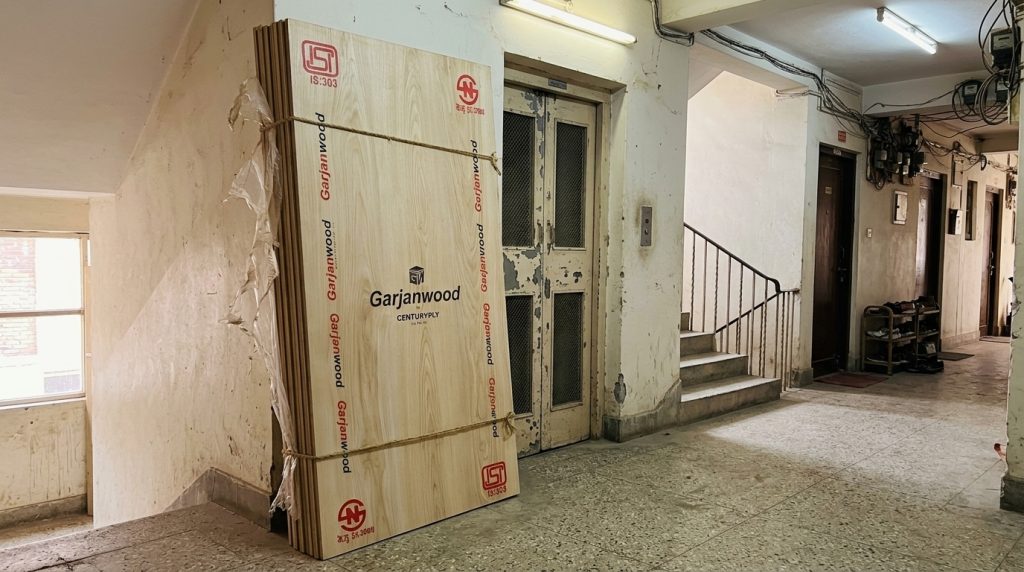
- Check lift and staircase access. Many Kathmandu apartments cannot take a full 8 ft sheet in the lift. Ask your dealer whether they can cut sheets to size before delivery.
- Inspect on delivery. Look at edges, surface and thickness, and check the markings on each sheet before the truck leaves.
- Store sheets flat, on timber battens, covered and away from damp walls.
A Nepal Climate Note
In the monsoon, delivery delays and wet roads are common, so place your order a little early rather than waiting for the last week. Plywood left in a damp site room can swell before work begins, so keep sheets raised and covered. In Kathmandu’s dry winters, boards can lose moisture quickly, so let them settle inside the flat for a day or two before cutting, which helps the finished furniture stay stable.
Quick Decision Box
Formula: area in sq ft ÷ 32 × 1.12, round up. Typical 2BHK: about 25 to 35 sheets of 18 mm, plus 5 to 8 sheets of 6 mm for backs. Always: get a cutting plan, order from one batch, add a small buffer, name the grade.
Order with Confidence
A clear estimate saves money, time and stress. Garjanwood by CenturyPly is manufactured at Century Ply Industries in Sunsari and is IS:303 certified, so every sheet starts with a recognised standard behind it. Take your measurements and cutting plan to your Biratnagar or Kathmandu dealer, ask for the sheet count and grade in writing, and begin your home with the right boards in the right quantity.