


Walk through any residential lane in Biratnagar, Itahari, or Kathmandu in the weeks before Dashain, and you will see the same thing: scaffolding half-wrapped in tarpaulin, carpenters measuring door frames, and trucks unloading plywood sheets faster than any other month of the year. Dashain and Tihar are not just Nepal’s biggest festivals; they are also the country’s biggest home renovation and furniture-building window. Families repaint walls, rebuild kitchens, replace old almirahs, and finish half-done rooms before relatives arrive. For plywood buyers, this creates a very specific set of pressures that do not exist during the rest of the year: shorter carpenter availability, tighter delivery timelines, and demand spikes that can affect both price and stock. Understanding why this happens, and planning around it, can save a homeowner weeks of stress and a fair amount of money.
Why Dashain-Tihar Triggers a Renovation Rush
The reasons are cultural as much as practical. Dashain is when extended families reunite, often in the ancestral home or the eldest son’s house. Tihar follows close behind with its own emphasis on cleaning, decorating, and presenting the home at its best for Laxmi Puja. Together, these two festivals create a six-to-eight-week period where “the house has to look ready” becomes a real deadline for millions of households.
This is not a Garjanwood-specific pattern. It shows up across the entire home improvement sector: paint sales rise, furniture showrooms run festival offers, and hardware stores extend their hours. But plywood sits at the center of it because almost every visible renovation project depends on it, from a new kitchen shutter to a fresh TV unit to a repaired door frame.
Three groups drive most of the demand:
- Homeowners finishing long-pending projects. A kitchen that has been “on the list” since Baisakh often finally gets built in Bhadra or Ashwin, timed to be ready before the festival.
- Families hosting relatives. Guest rooms, extra almirahs, and dining furniture get built or upgraded specifically because visitors are expected.
- New homeowners moving in before Dashain. Possession dates on new apartments and houses are frequently timed around the festival, which means an entire interior fit-out compresses into a few weeks.
What Changes During the Boom
Carpenter Availability Tightens
Skilled carpenters in Biratnagar and Kathmandu often book their festival-season calendar months in advance. A homeowner who waits until Bhadra to call a carpenter may find every reliable name already committed through Dashain. This pushes some households toward less experienced or unfamiliar carpenters, which is exactly when corner-cutting on material quality becomes more likely, not because the plywood changes, but because oversight does.
Dealer Stock Moves Faster
Popular thicknesses and grades, particularly 19mm and 12mm BWP-grade sheets used for kitchens and wardrobes, sell through faster during peak weeks. A dealer who normally restocks every ten days may see the same stock cleared in three or four. This does not mean genuine plywood becomes scarce, Century Ply’s supply chain from the Sunsari factory is built to handle seasonal demand, but it does mean popular sizes can be temporarily out of stock at a specific dealer on a specific day.
Delivery and Installation Timelines Compress
Transport from the factory to dealers, and from dealers to homes, faces the same seasonal load as everything else moving on Nepal’s roads before Dashain. A delivery that takes two days in Shrawan might take four or five days in late Ashwin. Builders who assume festival-season lead times will match off-season lead times often end up finishing furniture the night before guests arrive.
Quick Decision Box: Should You Buy Now or Wait?
| Your Situation | Recommended Action |
|---|---|
| Renovation planned for Dashain-Tihar | Order plywood by mid-Bhadra at the latest |
| No urgent deadline | Buy in Shrawan or early Bhadra for better stock choice and carpenter availability |
| Moving into a new home before the festival | Confirm plywood order and carpenter booking at least 6 weeks ahead |
| Small repair or single-piece furniture | Lower urgency, but expect longer dealer response time closer to the festival |
| Bulk order for multiple rooms | Place the order in writing, confirm sheet count and grade before the rush begins |

Planning Your Purchase Before the Rush
The single most useful thing a homeowner can do is separate the decision from the installation. The decision, which grade, which thickness, which dealer, does not need to wait for the festival to approach. Making that decision in Shrawan or early Bhadra, while dealers still have full stock and carpenters still have open calendar slots, removes almost all of the seasonal pressure described above.
A few practical habits make this easier:
- Measure early. Room dimensions and furniture requirements do not change with the season. Getting exact measurements done two months ahead means the order can go in the moment a carpenter is confirmed.
- Confirm grade before price. BWP-grade Garjanwood is built for Nepal’s humidity swings regardless of season, but during the rush, some dealers push whatever grade is in stock rather than what the room actually needs. Deciding the grade in advance protects against this.
- Book carpenters before ordering plywood, not after. A confirmed installation date tells you exactly when the plywood needs to arrive, which avoids both premature storage (where sheets sit exposed to monsoon humidity in a half-built room) and last-minute scrambling.
- Ask for a written order confirmation. During peak weeks, verbal promises about delivery dates are the first thing to slip. A dated, written confirmation from the dealer protects both sides.
Nepal Climate Note
The Dashain-Tihar window in Ashwin and Kartik falls right at the tail end of the monsoon, when humidity in the Terai is still elevated even as the days start to cool. Plywood delivered during this period, especially in Biratnagar and other Terai towns, should ideally go straight into installation rather than sitting stored in a half-finished, unventilated room for weeks. BWP-grade plywood like Garjanwood handles residual monsoon moisture far better than MR-grade, which is one more reason grade selection matters more during this season, not less.
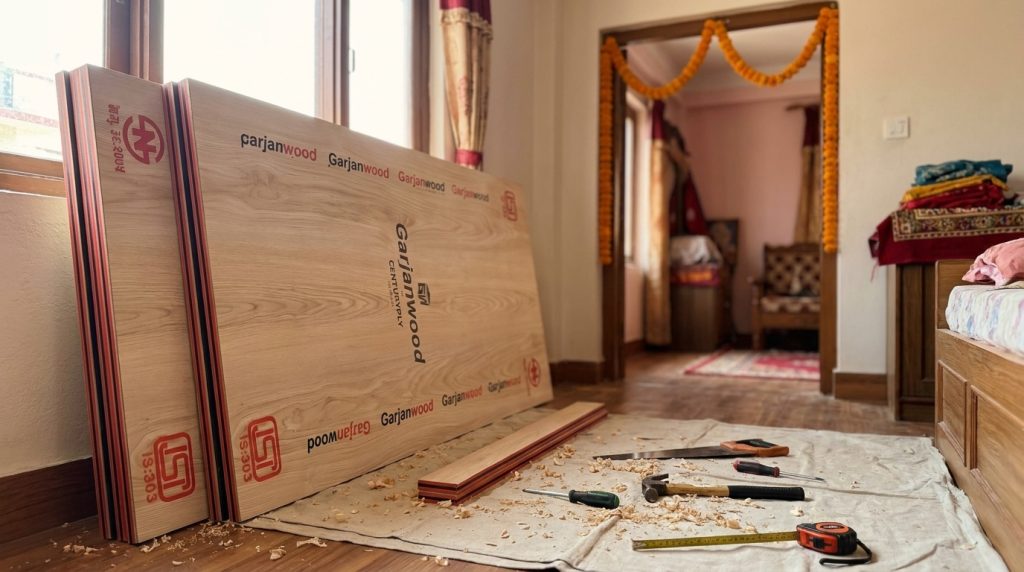
Dashain and Tihar will always be Nepal’s busiest renovation season, and that is not something any dealer, carpenter, or manufacturer can change. What a homeowner can control is timing: making material and grade decisions early, locking in a carpenter before the calendar fills up, and ordering plywood with enough lead time to absorb the season’s slower deliveries. Every Garjanwood sheet carries the same IS:303 certification and BWP-grade construction whether it is bought in Shrawan or the week before Dashain. The only thing that changes with the season is how much choice, and how much time, a buyer has to work with. Plan early, and the festival rush becomes a formality instead of a scramble.