


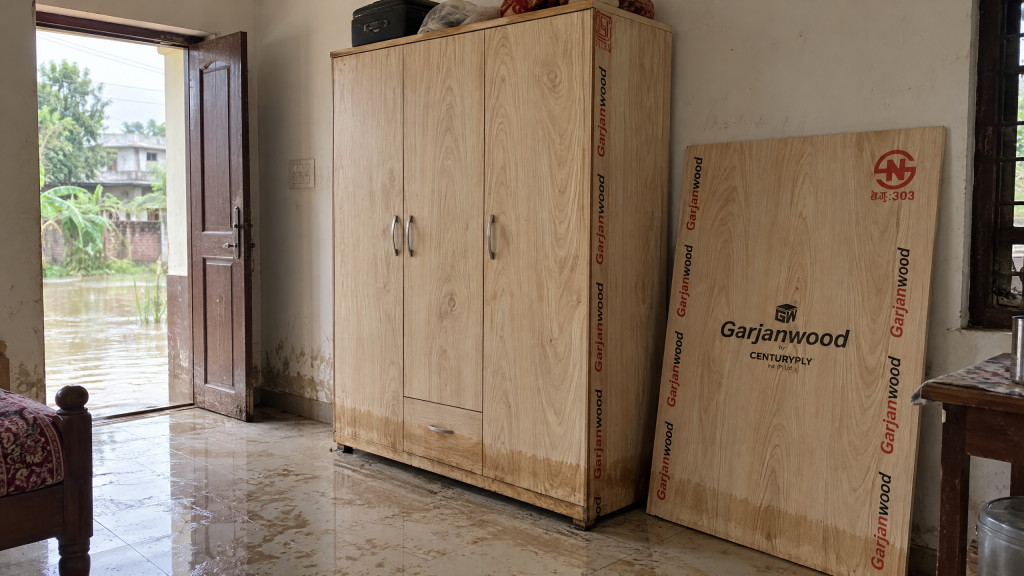
When the water finally goes down, the real question begins. Your wardrobe, kitchen shutters, bed and partitions were all underwater or soaked, and you have to decide what is worth saving. This guide to flood-damaged plywood is written for families and carpenters in Terai districts like Sunsari and Morang, where monsoon floods are a repeated risk, not a rare event.
First 48 Hours: Safety Before Salvage
Before touching furniture, deal with safety. Floodwater in the Terai is rarely clean. It often carries silt, sewage and farm runoff, so everything it touched should be treated as contaminated.
- Switch off the mains and have sockets and wiring behind plywood panels checked before use.
- Wear gloves, boots and a mask when handling wet boards.
- Photograph everything before you move it, in case you need records for any claim or repair estimate.
- Open doors and windows to move air, and remove standing water as early as you safely can.
Do not rush to drag heavy wet furniture across the floor. Soaked plywood is heavier and weaker, and it can split at the joints if lifted wrongly.
What Happens Inside Plywood When It Floods
Plywood is made of thin veneers glued in alternating directions. Water enters first through raw edges, then travels between layers. If the glue line is strong, the board can swell, dry and come back close to its shape. If the bond is weak, the layers separate, which is called delamination, and the damage is permanent.
Two things decide the outcome: how long the board stayed wet, and what grade it was. Boards made with water-resistant glue and proper pressing tolerate short soaking far better than cheap boards with weak adhesive. Time matters as well. A sheet soaked for hours behaves very differently from one that sat in standing water for days.
Can You Save It? A Quick Inspection Table
Check each piece one by one, in good light, once the surface water has drained.
| What you see | What it likely means | What to do |
|---|---|---|
| Surface wet, edges slightly raised, no layer gaps | Short exposure, bond intact | Dry slowly and refinish |
| Bubbled laminate or lifting veneer, core still firm | Surface bond failed, core may be fine | Replace the face or re laminate after drying |
| Layers separating at edges, you can slip a blade between plies | Delamination | Replace |
| Soft, crumbly or spongy core | Core is saturated or rotting | Replace |
| Strong sour smell or black spots | Mould growth | Clean and test, replace if it returns |
| Cracks along screw lines and hinges | Fasteners have lost grip | Re fix with new holes or replace the panel |
When you are unsure, press the surface with your thumb and tap along the edge. A solid sound and firm feel are good signs. A dull thud and a soft give are not.

How to Dry Plywood the Right Way
Fast drying feels logical, but it is the most common reason salvageable boards end up ruined.
- Remove loose parts. Take out drawers, shelves and hinges so air reaches every surface.
- Stand boards upright or on spacers. Lift them off the floor so air flows beneath and around them.
- Use air movement, not direct heat. Fans and open windows are far safer than harsh sun or heaters.
- Dry over days, not hours. Slow, even drying keeps the board from curling.
- Check flatness as it dries. Weight lightly over spacers if edges begin to curl.
Avoid leaving soaked boards in strong midday sun. The outer layer dries and shrinks while the core stays wet, which causes cracks and warping. In Terai humidity, drying can take longer than you expect, so patience is part of the process.
Mould, Smell and Hygiene
Mould starts within a day or two in warm, humid conditions, and the Terai provides both. Wipe surfaces with a mild detergent solution, let them dry fully, and then use a suitable antifungal treatment. Do not seal a damp board under paint or laminate, because trapped moisture feeds mould from the inside.
If a piece still smells musty after proper drying and cleaning, it is telling you the core is holding moisture. In a bedroom, kitchen or children’s room, replace it rather than keeping a long-term source of spores.

When to Replace Instead of Repair
Repair makes sense when the damage is surface level, and the core is firm. Replace when:
- The layers have separated, or the core feels soft.
- The panel carries load, such as shelves, bed bases or cot frames.
- It sits close to food, bedding or children.
- Mould returns after cleaning and complete drying.
Replacing one carefully chosen panel is usually cheaper than repeated repairs, and it removes the worry from the room.
Protect Your Plywood Before the Next Monsoon
You cannot stop a flood, but you can reduce what it costs you.
- Choose the right grade. For wet-prone homes, use boiling water proof (BWP) grade plywood for kitchens, lower wardrobe sections and bathroom-adjacent walls.
- Seal every edge and back face. Raw edges are the entry point for water.
- Raise the base. Mount furniture on solid legs or a plinth so the bottom panel is not in direct contact with the floor.
- Use laminate or good paint on all sides. An unsealed back panel absorbs moisture quietly.
- Keep ground floor storage modular. Panels that can be lifted out and replaced cost far less than a built-in unit.
A Terai Climate Note
Terai homes face a double problem: floods in the monsoon and persistent humidity even between floods. Standing water pushes moisture deep into boards, but humidity alone can slowly swell edges and loosen hinges. After any flood, plan to inspect furniture again a few weeks later, once the house has dried, because hidden swelling and mould often show up late.
Quick Decision Box
Dry and keep if: the board is firm, layers are tight, and there is no musty smell after drying. Repair if: only the laminate or veneer face has lifted and the core is solid. Replace if: layers are separating, the core is soft, or mould keeps returning. For next time: BWP grade, sealed edges, raised base.
Rebuild with Confidence
Flood season tests every board in your home. Garjanwood by CenturyPly is made at Century Ply Industries in Sunsari, a region that knows these conditions well, and is IS:303 certified for bond and board quality. When you replace flooded panels, ask your Biratnagar or Kathmandu dealer for the grade that suits wet-prone rooms, and rebuild so the next monsoon passes with far less worry.