

Remittances now account for roughly a third of Nepal’s GDP, the highest share ever recorded according to the government’s latest Economic Survey. Behind that statistic are hundreds of thousands of families managing a home construction or renovation project from a distance, while a husband, wife, son, or daughter works in the Gulf, Malaysia, or South Korea and sends money home for exactly this purpose. It is one of the most common, and most stressful, versions of homebuilding in Nepal today: a family member overseeing masons and carpenters they didn’t personally vet, trusting quality decisions they can’t physically inspect, often over a phone call with a patchy connection. This post is a practical guide to verifying plywood quality for remittance-funded construction projects in Nepal, so families managing a build from a distance can specify materials with confidence instead of guesswork.
Why Remittance-Funded Construction Is Different
Unlike a typical local buyer who can walk into a dealer’s showroom, touch samples, and negotiate face-to-face, a remittance family often has one household member on the ground in Nepal, a parent, spouse, or sibling, coordinating with a contractor while the person funding the project is thousands of kilometres away.
The scale of this pattern is significant. Remittances are estimated at 33.02 percent of Nepal’s GDP in the current fiscal year, up from 27.80 percent the year before, the highest ratio ever recorded. More than 400,000 Nepalis took first-time approval for foreign employment in a recent half-year period alone, with major destinations including India, the Gulf countries, Malaysia, South Korea, Japan, Australia, and New Zealand. Behind every one of those approvals is usually a family back home managing daily decisions, home construction very often among them, without the person who earned the money present to weigh in.
The financial stakes are high. Money sent home over months or years is often earmarked specifically for home construction, and a material decision made by a contractor who assumes the remote owner will not know the difference can waste a meaningful share of hard-earned foreign income. Trust becomes the scarce resource here, more than money. This post focuses on protecting that trust using verifiable material standards rather than relying purely on a contractor’s word.
The Core Problem: You Cannot Inspect What You Cannot See
Contractors or carpenters sometimes substitute lower-grade plywood for a project once the specifying family member is out of the country, particularly for interior work like modular kitchens, wardrobes, and partition walls, where the difference is not visually obvious to an untrained eye, especially in a photo sent over a messaging app.
Family members managing the project locally, often parents or a spouse, are frequently not construction experts. They may not know what questions to ask a contractor, or may feel uncomfortable challenging a tradesperson’s material choices out of politeness or deference. The result is a quality gap that does not surface until months or years later, when panels delaminate in monsoon humidity, swell, or fail structurally, by which point the remittance-funded budget has already been spent, and the person who funded it is still abroad.
What to Ask For, No Matter Who Is Managing the Site
- Ask for the brand name and grade printed on the plywood sheet itself, not just what the contractor states verbally.
- Ask for a photo or short video of the sheet’s edge and corner stamp before installation, so any substitution can be caught before panels are cut and fixed in place.
- Confirm the grade matches the application: BWP, boiling water proof, grade for kitchens, bathrooms, and exterior-facing furniture. MR moisture resistant grade is not sufficient for these high-humidity zones.
- Call the dealer directly to confirm the specific batch supplied matches the brand and grade billed, since a dealer can usually verify this independent of the contractor.
- Keep the delivery invoice and brand documentation as a record, the same way you would keep documentation for any other high-value remittance-funded purchase.

Why IS:303 Certification Solves the Remote Verification Problem
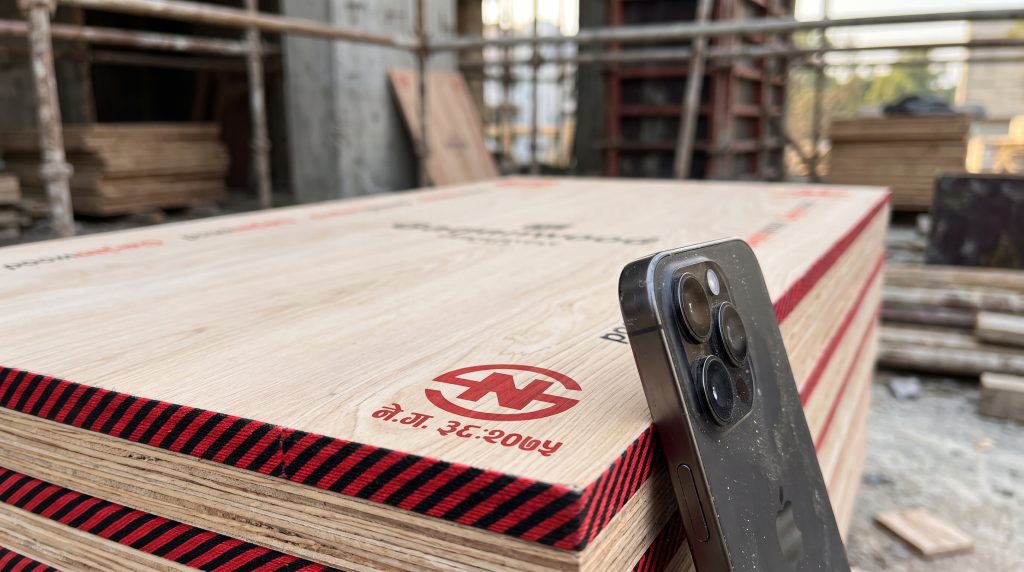
IS:303 is a recognized quality mark that can be visually verified on every individual plywood sheet, not just claimed by a salesperson, which means a family member with zero construction background can still confirm compliance by looking for the stamp itself. Garjanwood plywood is stamped with circular red IS:303 certification marks at all four corners of every sheet, manufactured at Century Ply Industries in Barju-01, Sunsari, so the standard travels with the physical product to the job site, not just the invoice.
This turns quality verification from trusting the contractor’s word into looking for the stamp, a task any family member on the ground can do over a video call by pointing a phone camera at the delivered sheets before installation begins. A simple habit worth building into every delivery: ask the person on site to send a short video of the plywood stack on delivery day, showing the branding, the edge stripe, and the corner stamps, before the contractor proceeds. It takes minutes and creates a clear, verifiable record.
A Simple Remote Verification Checklist
- Before delivery: confirm brand and grade with the dealer directly by phone.
- On delivery day: request a video or photos of the stacked sheets, showing edge branding and corner stamps.
- Before installation: confirm the grade matches the room, BWP for kitchen, bathroom, and exterior-facing furniture.
- Keep records: save the invoice, delivery photos, and dealer confirmation together for the household file.
- If in doubt: call the dealer, not just the contractor. A reputable dealer will confirm the batch supplied.
Building Trust Into the Process, Not Just the Budget
Remittance-funded construction succeeds when the family builds a simple verification habit into the process from day one, not when they try to audit everything retroactively after a problem surfaces. A five-minute video call showing delivered material, repeated at each major material delivery, plywood, tiles, fittings, costs almost nothing but closes the information gap that distance creates.
This habit also protects the relationship between the family and the contractor. A contractor working with a family that visibly checks documentation from the start has less incentive to cut corners in the first place, which tends to improve the quality of the entire project, not just the plywood.
Nepal Climate Note: Why Grade Selection Matters More in Absentee Builds
Incorrect grade selection, using MR grade where BWP is needed, often does not show visible failure for months. That delayed timeline is exactly the kind of problem that is hardest to catch remotely, since the family member abroad will not see the damage until it has already happened. This is especially true in Terai districts like Sunsari, Morang, and Jhapa, where monsoon humidity between June and September puts real stress on any plywood that was not specified correctly. Grade verification at delivery time matters more for remittance-funded builds than for locally supervised ones, because there is usually no opportunity to catch and correct a mistake after the fact once the interior work is finished, covered, and the person who funded it is back overseas.

The Garjanwood Standard
Garjanwood plywood is manufactured in Sunsari and stamped with IS:303 certification on every sheet, giving families managing construction from a distance a verification standard that does not depend on being physically present. Whether you are the one on the ground in Nepal or the one funding the project from abroad, ask your dealer for Garjanwood BWP grade by name, and make checking the stamp part of every delivery.